Map of Tonga in the South Pacific

Map of Tonga in the South Pacific

Saturday, January 28, 2012

Veimau or Tongan Checkers

Written by Jim.
One of Jim's counterparts from TIST and TIST students plays draughts under the mango tree.

Well, let us just say that Tongans play American Checkers or English Draughts differently than anywhere else in the world. (Although according to Wikipedia there is a similar variations played in Russia, and another in the southeastern United States.) I was first introduced to this game, while sitting under the mango tree at my school, by my students and co-workers. They were playing with a rustic homemade board and pebbles, big pebbles v. small pebbles, which sometimes caused confusion late in the game if a medium size pebble was involved. Actually, if you look you can find the game being played all over the Kingdom of Tonga. There are usually two games going at the market, each with its own crowd of men around, each taking a turn trying to win a game so he gains control of the board and plays the next game. I have only played one game in the market, and my opponent was, to say the least, most gracious, and surprised that a non-Tongan knew how to play. I digress. Games are played in every schoolyard, in the parks, at the bus depot, or just on the sidewalk. Grab a stone and scratch a board out, make two sets of checkers out of stones, bits of mango skin, pieces of glass, etc., and play. Serious players have a painted board and use bottle caps for checkers. 
Jim gets beat playing draughts at the market.
 Since I walk a lot in Tonga and there are always bottle caps on the ground, I started picking them up. Blue ones are easy (water bottles) but a second color was harder. I finally settled on red, more Coke drunk from bottles, besides red is easy to spot. I have now picked enough caps for more than 6 boards and still going. So how do Tongans play Draughts? Well let's see.
 

Standard 64 square  (8 x8) checkerboard, 12 checkers each side, checkers placed so the long diagonal of the squares used runs from lower left to upper right.

Checkers (pate) can only move forward (as in standard checkers), BUT can jump forwards and backwards. Jumps must always be taken. If you have a choice of more


than one jump or jumps, you take the one that you feel will provide you with the best advantage, not always the one that captures the most , but once a sequence is chosen you must take all of the jumps in that sequence.
Red's first move
A few moves later red jumps three

Ending up in this position, Blue now must take one of the two possible jumps.

Hey, but that's not all. If you are lucky, or skilled enough, to reach the back or king row, the real fun begins. Kings  (called flying kings in some variant games) can move backwards and forwards along the diagonal, as does a Bishop in Chess, but after jumping an opponent's pate (checker) you may change diagonals anywhere after the jump to jump another and another etc. I have seen as many as five (5) go down with one king's jumps.
Up the diagonal turn and down into the corner.

 Also, if you jump an opponent's checker to become a King you can proceed to continue to jump as many as you can.
There is another variation called Foaki were the object is not to end up with all your opponent's checkers gone, but where you manage to give away or lose all of your checkers. All of the above rules apply. I have run into two variations of this one:
      You must offer a checker if you can and
      You don't have to move into a jump but can try to setup for giving away as many                 
      checkers as you can.

Wednesday, January 25, 2012

Mango Mania


Sitting under a mango tree (It's always coolest under a mango tree.) and eating a ripe mango. Doesn't she look happy?
 Starting last week eating mangoes became a national pastime. Last year we had no mangoes on our island of Tongatapu. So many things, I learned, affect the growing of mangoes: wind or a storm when they're flowering, strong winds while they're developing. Everyone has been watching the mango trees--and waiting and hoping.

A mango tree in bloom. Now the waiting begins.

Mangoes almost ready to eat. I'm learning when they're ripe. They still seem hard to me, but, of course, the Tongans are right, and they're ripe when they tell you they are.
 They're ripe and ripening! Everywhere I look people are eating mangoes. They're throwing rocks and sticks at the trees to knock them down. People are sharing them. Everyone is happy eating them. They either have some or they're looking for some. Yesterday a teacher gave me a 2-litre ice cream container full of already skinned mangoes. What a sweetheart! We eat them with cereal. I've made mango salsa. They're delicious with yogurt on pancakes. We have mango banana bread in the freezer. We just eat them. Some Tongans eat them skin and all--well, not the large pit. That you just suck clean. Mangoes that have ripened on the tree are like eating sunshine. It makes you happy all over. The season is short, and when they're gone, they're gone. Eat on!

Lunch was late for our teachers' workshop, so out came the mangoes as an appetizer. They came out of bags and containers. Everyone was offered one--or more. (We're in the meeting hall of Beulah College, which is a Seventh Day Adventist high school.)
People at TIST try to get their mangoes using a pole...
and a ladder.


The happy look a mango brings.


Friday, January 20, 2012

Aotearoa, Long White Cloud


Since we have hundreds (!) of photos and upload time is shower than snail pace (watching paint dry?), and I dislike long travelogues, I've been debating on how to best blog about our trip to New Zealand, as it is something I want to share with all of you. As I looked over all our photos (Jinnet's, too), it's interesting to see what we most photographed--scenery, of course!, waterfront views, meals and food we ate.

All three of us like to cook--and eat. One goal was to eat good food, especially foods we knew we wouldn't get to eat for another year. Many Volunteers tell me that their first stop is McDonalds when they go home or on holiday. That never crossed our minds! We ate lamb, hare, ribs, and venison. We ate whitebait fritters, slices, and meat pies, which are NZ specialties. There was excellent coffee, Guinness, and good affordable wine. Two of our B & Bs served a wonderful hot breakfast, and we never said, "No thank you." Once a day we gathered in a room for a meal that always included good cheeses among other yummy foods we craved. We ate in cafes, fine restaurants, and carry-out eateries. I will spare you the food photos.

What will be our lasting memories? What photos will mean the most in future viewings? Some memories, of course, can't be captured in photos. Those become ours alone, to be savored and brought out at will. Perhaps the sweetest of all.

The North Island: Auckland, Overlander train trip from Auckland to Wellington, and Wellington.  Auckland is New Zealand's largest city and sits toward the north end of the island. Wellington is the capital and is at the south end of the north island.  We took a 12 hour train ride from one to the other.

On the waterfront with part of the Auckland skyline behind us.

We attended the Festival of Nine Lessons and Carols at the Auckland Cathedral of the Holy Trinity.

Here we are as Twits. What fun to see this performance, which had an audience full of children, parents, and grandparents out for a special time.
On the Overlander and in the observation car in the back.

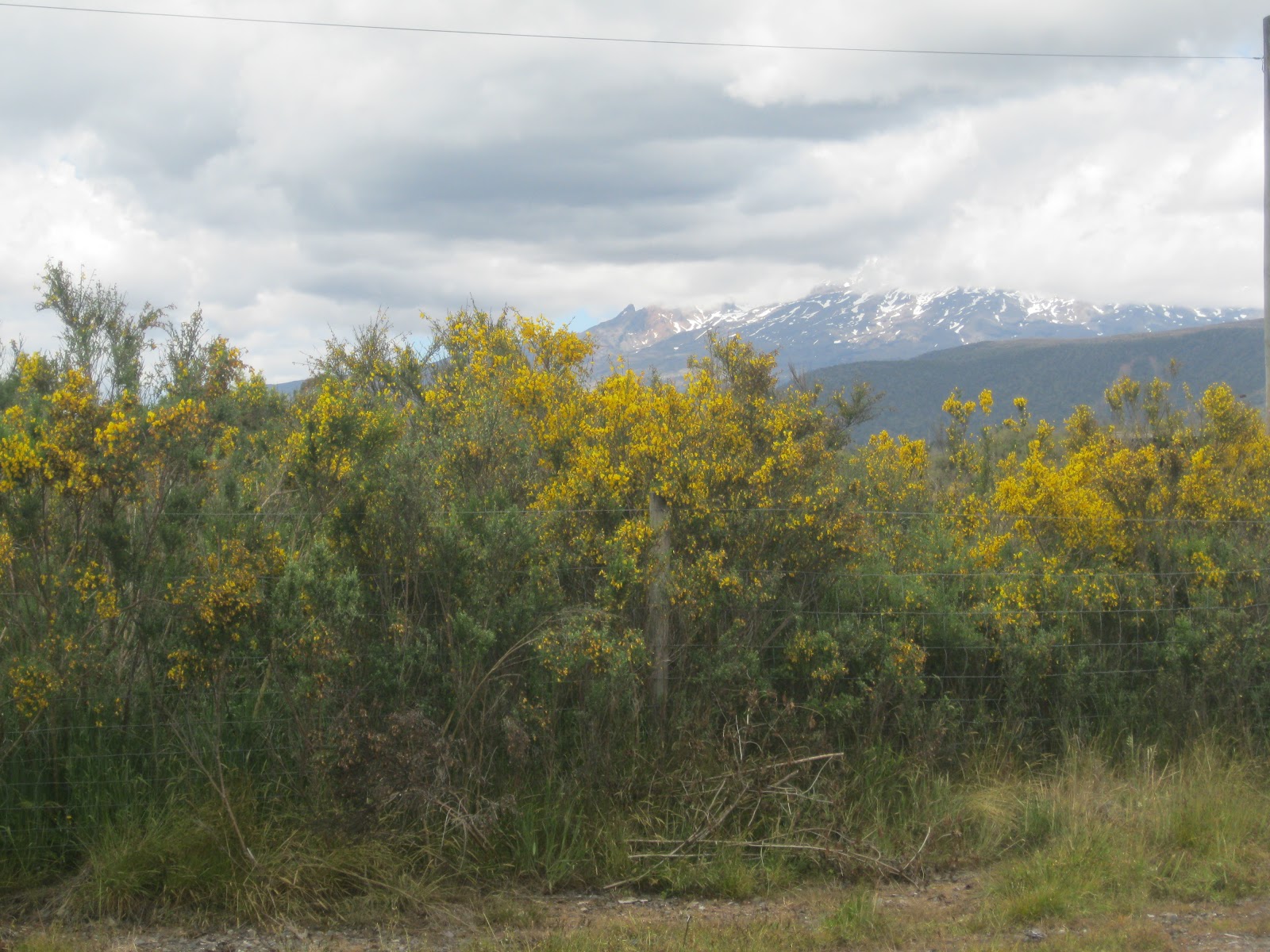
View of mountains.

Looking backward over a bridge.

We crossed many rivers, and one river many times.

New Zealand's seat of government in Wellington, the Beehive.

Wellington waterfront.

Wellington waterfront with a view of the city.

A Wellington beach. 


We took a cable car to the top of a hill to get to the arboretum. This is the view looking over the city. We then walked down through the arboretum and back into the city.

Arboretum rose garden.

Carving of a bee lady at the arboretum.

Te Papa Museum in Wellington.

Maori welcome to the demonstration of their culture.(Te Papa)
Maori guide poses with us. (Te Papa)
 The South Island: Dunedin, which is on the east coast, and quite far south and has the Otago Peninsula nearby; Te Anau, on the west coast and near Fiordland; Doubtful Sound (fiord), and the road to Milford Sound (fiord).

Dunedin's Railway Station.

The rose garden in the arboretum near our B & B in Dunedin.

Yellow-eyed penguin seen on the Otago Peninsula tour.

The boat ride on Manipouri Lake.

During the bus ride to the power plant our bus driver gave us time for photo ops.

Manipouri Power Plant, which is built entirely underground. (Ask us  if you'd like to know more about it.)


On the boat on Doubtful Sound.

One day we drove the road from Te Anau to Milford Sound, taking time to enjoy the sights.
One the road to Milford Sound.

Gunn Lake on the road to Milford Sound.

Wednesday, December 14, 2011

In a far, far galaxy... (or, same same, but different)


In other words, a Sunday School Christmas Program is pretty much the same here as in any church we've ever been to. We were invited to attend a program at an Anglican church. There was a Christmas tree and decorations, joyous Christmas music, earnest children presenting the message, and anxious adults directing them.  And it was in English! The biggest difference? A 3-hour program. A little long for American tastes and sensibilities, but normal here. Every class level had something to share--songs, dramas, dance, and most of all, joy. Each child received a present by name from the pastor, and delicious refreshments followed. Here's a small sample of the sights and sounds of the evening:
In a corner on the stage.

Older youth present a drama and dance.


Preteens sing and dance.

Another dance with holiday music and a message for the season.
An adult director dresses for the evening.

The littlest angel didn't quite make it to the finale.

We were invited to be a part of an International Volunteer Day program, and I wanted to share this music from it. The singing group is from Tupou High School, and the band from Tupou College.


Kalisimasi fiefia! This is our Christmas card to all of you. May you have a blessed Christmas with family and friends, and a wonderful New Year!

Tuesday, December 6, 2011

Pomp and circumstance, Tongan style


Students wait for the practice and others bring benches for additional seating.

Prizes for students vied with reports for room on the library tables.

I arrived in the library on Wednesday, November 30, to find the tables piled high with wrapping paper and "prizes" or awards for the top 3 students in each class. Teachers were wrapping, while others were completing their grades and reports. Outside a tent had grown in the playground overnight, and students were bringing the benches from their classrooms for the program's seating for tomorrow. No one wore uniforms, and many students elected to stay home. It was a 1/2 day, with only the practice scheduled for it.  At midmorning the form 2 students went through their marching routine, and students were taught how to receive their awards. The top 10 in each class would be recognized, and the top 3 would receive prizes.

A final sweep to the area before the big day.

Students are ready and waiting.

A class 3 student waits quietly.

It was not a normal day when I walked onto the school grounds the next morning at the usual time. It was too quiet. Only a few students were around and a teacher was giving the area a last sweep before the day began. Two Form 2 students came in the library and were already sad and nostalgic to see their years at Hilliard ending. A little before 9 the Beulah Band arrived, more people came, and it was beginning to look like something special was not only planned, but was going to happen.

Form 2 students march in and salute and wait during the playing of the National Anthem and the raising of the flag.

A student receives recognition for a job well done.

Top 10 class 6 students bow after receiving their awards.


The students of Form 2 marched in, the band played the National Anthem, there were prayers, hymns, welcomes and speeches before we got to the real reason for the day: the awarding of recognition to the top ten students in each class for their academic work and achievement during the past school year. Children were festooned with kahoa, (leis) and proud and adoring parents presented them with more. Photos were taken. 

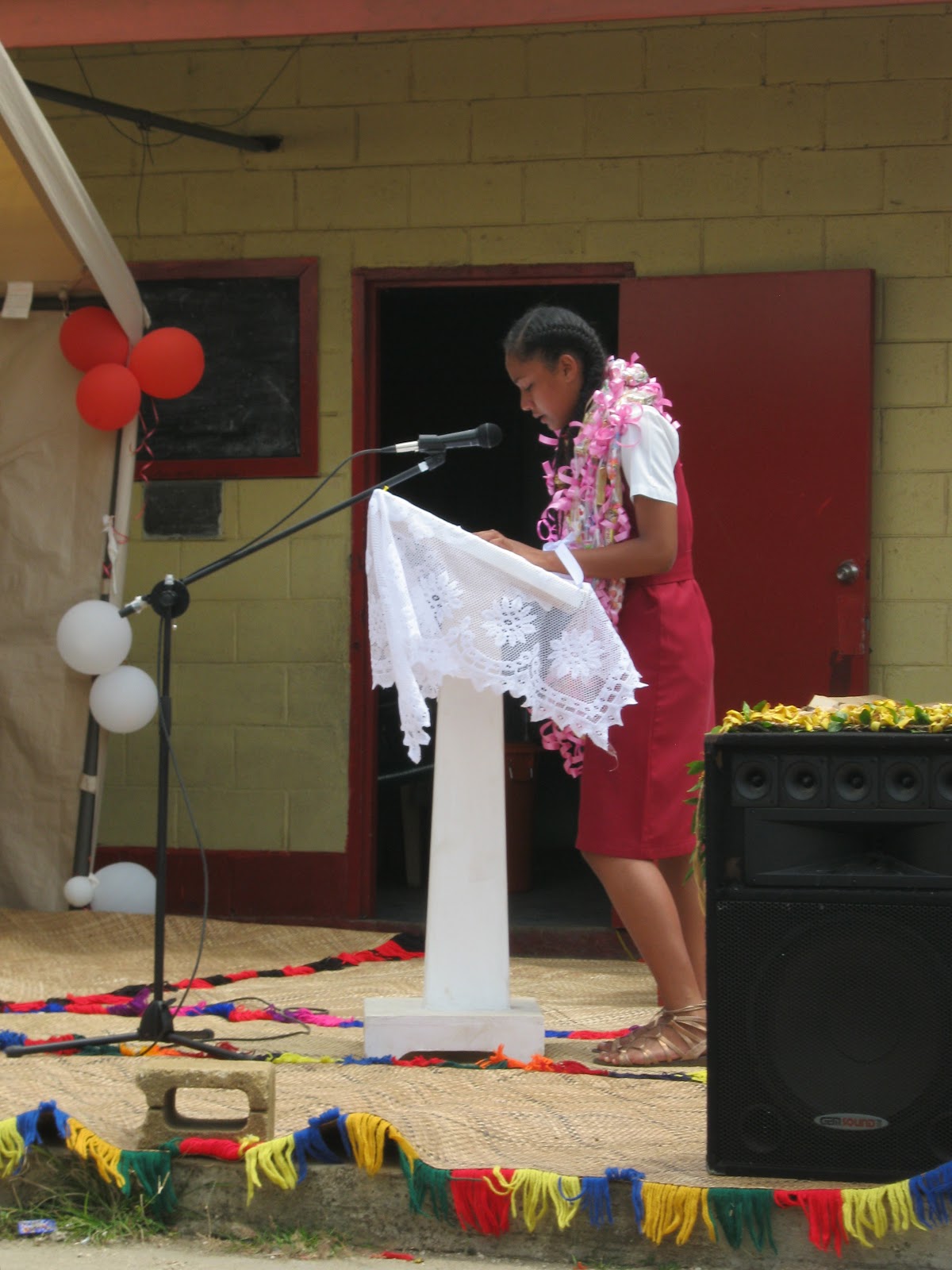
The band played during a couple of interludes. My favorite piece was a medley of "In the mood," "Rock around the clock," and "Barbara Ann." The top Form 2 student made a short speech. 
Form 2 students getting final instructions before receiving their awards.

Valedictory speech by the top Form 2 student.

The National Anthem played again, and it was over. Another school year done, achievements acknowledged. It wasn't long before most had left, the band members were served lunch, and the process of putting everything away was begun. Now, a holiday break--a time for resting and recharging. Soon the 2012 school year would be under way.... A teacher and her husband had offered me a ride home, and as I crossed the playground to climb into their truck the thought was--how will I feel at this time next year?