Map of Tonga in the South Pacific

Map of Tonga in the South Pacific

Wednesday, March 16, 2011

More this 'n' that/Books

February 5, 2011

More this ‘n’ that….
 

Rain (‘Uha)

It’s Saturday and the first semi-cloudy, rainy-type day in a while. I welcome it! There’s a breeze again.

Saturday is a time to clean up the yard and get ready for Sunday. The family next door had everyone out early this morning raking, cleaning, fixing up the yard, both parents and children. Rain shower? Sai pe (Kind of like, ok, no worries. Pronounced “sigh pay.”). Just keep working. No one runs for cover or worries about getting wet. In fact, a good rain is a great time for taking a faka’uha, or rain bath. Remember as a kid running outside in a swimsuit during a shower and playing in the puddles? We need more of that! Sai pe.

Bananas (Siaine)

A single banana is called a finger; a cluster of fingers is called a hand; a stalk of hands is called a bunch. There are several kinds of bananas, not just one, like in the States. There are fat, short ones called butter bananas, some that are smaller with good banana flavor, but not quite as strong as ours, and we’ve also had a variety that is starchy, and is boiled or baked. You can buy bananas by the stalk or by the hand, and a hand of bananas can go from green to ripe in a couple of days. So share, share, share. Of course I’ve made banana bread, and that’s good for sharing, too.


Oh, yes, and he’s my cousin

Coming from a small town where we were related to no one because we had moved there as adults, we got used to knowing that everyone (well, almost everyone) was related. Guess what? We moved from one “small town” to one “small group of islands.” The culture here is very family-related, and people know the generations forwards and backwards. When Jim asked a co-worker if he knew the Tongan player on the Pittsburgh Steelers, he said, “Yes, and he’s my cousin from the same island I’m from. His brother plays for the Washington Redskins.” Another PCV was talking to a co-worker about a librarian on Tonga, and she said, “Oh, yes, and she’s my mother-in-law.” And so it goes, as in small town, U.S.A., it is in Tonga.


A cover of one of the new books.

February 6, 2011

Books

Friday, February 4, was a big day for Tonga, especially the children, but probably no more than 60-70 people witnessed it. Since my assignment is to work at the CDU (Curriculum Development Unit), I was there to witness it and mark the occasion. It wasn’t learned until late on Wednesday that the newly printed pupil books would be arriving on Thursday from New Zealand. These books had been written by the CDU staff to accompany the new curriculum for Tongan language (Classes 1-6), mathematics (Classes 1-6), science (Classes 1-6), and English language (Classes 3-6). The exciting thing about this curriculum is that is has a Tongan focus in all the areas, and it is integrated into the learning. Funded by New Zealand, this is the first time that student books will have high quality printing, illustrations, and standard formatting. I haven’t seen them yet, but I can’t wait!

On Friday afternoon a ceremony was scheduled to “hand over” the books from the New Zealand High Commissioner to the Minister of Education.  On Thursday a tent was erected. On Friday morning the 3 shipping containers of books arrived, along with deliveries of flowers, chairs, and mats for the floor. Caterers delivered food, as well as the staff making delicious sandwiches. (I got to help!) The ceremony began at 3 P.M. with a hymn and prayer. Words of thanks were given by the Acting Director of Education, the CDU Chief Education Officer, and the Deputy Director of the CDU. After a short ceremony when the New Zealand High Commissioner and the head of the printing company officially gave the books to the Minister of Education, Women Affairs & Culture for the people of Tonga, the Minister also gave a formal response of thanks. Students of the Tonga Institute of Education (a college for teacher preparation) sang and danced.

I loved the Tongan ceremony, and the desire by them to mark this special occasion with all the formality, pomp and circumstance it deserved. It was all planned and accomplished in a very short time, with all the details arranged to make for a beautiful and meaningful celebration.
Getting everything ready.


Guests are arriving.
The official ceremony to receive the books.

The entertainment.
Refreshments.    

Thursday, March 10, 2011

School days, school days....

January 17, 2011

Teacher Dedication Service

Today when I got to work I found out I, along with everyone else, would be attending a church service this morning. If you read an earlier post about being flexible, here was another opportunity.

This is the week for teachers to prepare for the new school year. The church service, really a dedication service, was being held by the Ministry of Education, Women’s Affairs, and Culture. The new Minister, Hon. Dr. ‘Ana Maui Taufe’ulungaki, was the guest of honor. She had recently been selected to be the Minister by the newly formed government, and she was one of two Ministers who were not part of the elected assembly. She has a long history of being part of education in Tonga, and is highly respected.

The service was held in Queen Salote College’s (High School to us.) Hall at 10 A.M., which isn’t too far from my workplace. The Hall was large and was filled with teachers. The Tonga Police Band played. Hymns were sung and prayers were said, along with Bible readings and a sermon. There was a presentation of certificates and gifts to retiring teachers, and it closed with the National Anthem. Afterwards a lunch of traditional Tongan foods was served.

I thought myself very fortunate to be able to attend and to experience another slice of Tongan life and culture.


Acknowledging retiring teachers.


Music provided by the Police Band.


Food and fellowship


School Days

The week of teacher preparation is over and it’s time for the children to come to school. You remember the first day of school, don’t you? It’s the same here. There is a primary school right next to where I work, so I strolled over to get a feeling for a Tongan first day. Parents were dropping children off. Those with young children stayed with them.
The uniforms were crisp and new looking, and the sandals were leather. Everyone looked his/her best. Everyone was funneling into a center area of the school. When it was time, everyone got quieted down. The children sang a hymn, a prayer was said, and teachers began having students line up by grade level. The beginning of a new school year is always full of such promise, and there’s that buzz of excitement. Yes, it’s the same.
Coming to school.     
Gathering and waiting.

Thursday, March 3, 2011

At last---a Volunteer!

January 14, 2011

I’ve just begun writing again. We were without a computer for the last 3 weeks, and now we’re back in business. But before I move forward, I need to take you back to our Peace Corps Swearing-In Ceremony because it’s not every day that you become a Peace Corps Volunteer!

December 15….

I’ll only do a little commentary and let the pictures speak for the day.

We were taken by bus to a beautiful spot on the Lagoon. The weather was sunny and warm. We had posed for pictures outside the House where we were staying after getting dressed in our finest. We had practiced what we would be doing, and 2 groups were going to perform the dances they had learned for Culture Day in Ha’apai. How wonderful that Peace Corps does everything possible to make it a very special ceremony. We sang the U.S. National Anthem, dignitaries were there to greet and congratulate us from Tonga, as well as our Country Director. One of us gave a thank you speech—in English and Tongan. Hymns were sung. Then it was time for the certificates to be given out, and we each had our moment.

Afterwards we had a delicious light lunch before it was time to board the bus as Peace Corps Volunteers, Group 76.

A photo op before we left.           


Waiting.

Dignitaries.

Speech by our fellow Volunteer.


An official Volunteer.

Me, too!


Entertainment by our new Volunteers.


First week in December….

This was the week called Attachment. We had a wonderful opportunity that week to connect with my future co-worker. Although she couldn’t really help with learning my job, as she is in another department, getting to stay with this woman and her family was very special. She lives 22 miles to the east of Nuku’alofa, and we got to see a part of the island we hadn’t been able to see before. There is a significant historical site nearby that we saw and we hope to explore more thoroughly in the future. She loves to garden, and how I enjoyed looking at all her flowers. They have a wide, welcoming porch that we sat on that caught every breeze. It was a wonderful 2 days.

Tuesday, February 22, 2011

GPS Culture Day


November 29, 2010

Ha’apai GPS Culture Day

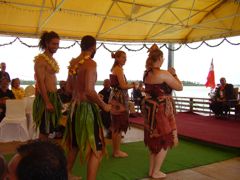
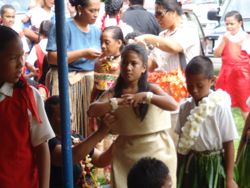
It’s the end of the school year and all the Government Public School (GPS) children gathered at the Wesleyan Hall in Ha’apai. It was supposed to be outside, but we had a lot of rain. People—parents, relatives, friends, school children, and teachers started gathering there over an hour early. My guesstimate was 700-800 people. Music played loudly while we waited for it to start: polkas, Christmas songs, such as Winter Wonderland, Jingle Bells, Joy to the World, Feliz Navidad, and The Little Drummer Boy. All were in English except Feliz Navidad. Five schools (I think) were represented. After the opening prayer and welcome, each school performed one or two dances. You could tell the students and teachers had spent a lot of time learning them, and they danced with pride and precision. The costuming was beautiful. The village school where we live with our host family also participated, and it was fun to see the children we knew perform.

I’m so glad that the Peace Corps encouraged us to attend. What a wonderful way to experience another aspect of the culture by seeing the traditional dances. The encouragement, support, and pride of the families for the children was inspiring.

Arriving at the Hall.


Inside the hall and on stage.


The children gather and wait in school groups.
Host family members.


Getting ready to perform.


Sharing.

Wednesday, February 16, 2011

Ping pong anyone?

 Last Sunday we had a special Sunday feast with 3 of last year’s Peace Corps Volunteers who lived in this house and this village. Somehow the large kitchen table was moved to the porch as we all ate together. The table has remained on the porch. Yesterday ping pong paddles and a ball appeared, And the ping pong battles began.

This afternoon I was trimming the fibers for Jim’s kafa (the rope that ties his tu’avala). I had a ringside seat to observe the games. Four males (3 teens and one adult) were playing. The four young children were underneath, or playing/squabbling nearby. The 2 women of the family came in and out as they had time, or when the children needed them. It was great fun with a lot of teasing and laughing. One young man took it all very seriously, and would argue heatedly that he had made the point, or that his competitor hadn’t. The rest were more easy-going about the whole thing. They played for several hours. A great way to spend an afternoon. It rained, but we were covered and protected.

Now it’s evening and I noticed that the table has been moved to the back of the porch again. Will the ping pong games continue? I hope so. Maybe I should start practicing… I used to be pretty good a lifetime ago. Hmmmm….


November 27, 2010

Happy Thanksgiving!

What a grand day it was! All 26 of us gathered at the Hall with our food. The village groups had planned the dishes, bought and prepared the food.

But let me back up and explain more about the day…..

Our host family attends the Wesleyan Church, and today was also a feast day for them---Misonale. It’s the day that each family contributes a yearly donation for the work of the church in the coming year. So, the preparations were of epic proportions. Many people were there to help. Five suckling pigs were roasting over an open fire, the umu (underground oven) was packed full, 8 cakes had been baked in the umu last night, the kitchen was full of side dishes, chicken marinating in soy sauce and garlic, and the list goes on and on. Add to that ---it rained all morning. Children played on the porch.

Now here come 4 Peace Corps Trainees with a turkey, ingredients for dressing, and gravy to make. Talk about stretching a kitchen beyond its limits! Well, we had asked to use the electric roaster and we took it to our bedroom to heat. Before they got too involved in the kitchen (7-8 A.M.) we mixed up the dressing and put it in foil packets, put the turkey in the roaster, along with the dressing, and got out of the way. (Oh, and we ran out of salt and had to find some in the pouring rain. But crisis averted, and the salt was added.)  About 11:30 the turkey was done, and we managed to borrow enough utensils to get the gravy made. Hooray!

When we came back, our family was at church and we cleaned up our pans. Then it was relax and enjoy. Some of the older children and teens were here, and they took care of younger ones and played ping pong while the adults were in church. The rain stopped in the late afternoon.

A great, successful day was had by all!

                                                            Getting ready for Misonale.
                                               Peace Corps volunteers gather for Thanksgiving.

Monday, February 7, 2011

Need a basket? Make one!

November 13, 2010

Every part of the coconut and the coconut tree gets used. The coconut is used at every stage of maturity for food, too. We had seen some very functional, but attractive baskets being used to carry food from the bush, particularly root crops such as manioc, sweet potato and taro. Of course I wanted one. Last week when Jim went to the garden in the bush he saw Mosese starting to make one, and he asked him if he would show him how sometime. Mo took it apart and said he’d bring the coconut leaf home and Jim could make it. In the bush it takes about 20 minutes to make one, and you only need a knife to split the spine to cut it open when you’re done. Otherwise, all you need are your hands and a coconut leaf. I’ve got some pictures that will give you an idea of the steps and how it is woven. Ingenious, huh?


 Last Sunday we attended church in the village that is 2 villages away. It was a special Sunday as there was a guest pastor at the Wesleyan Church there from Nuku’alofa. We had walked to that church just the week before to see it. It was built in the old Tongan style of architecture, which you rarely see anymore. I have pictures from the walk, but it was a treat to worship there, thinking of the people who had built it and worshipped there over the years. If only walls could talk!


 Our formal language classes are over, though, of course, tutoring remains. We had our Mock LPI on Friday (language pretest) and what a milestone that is! Here is our language group with our very capable and patient teacher. Thanks, Ofa, for all your hard work and caring so much that we did the best we could. We always come to Center Day in our professional dress—what we will be expected to wear to work and on Sundays.


Sunday, February 6, 2011

Road to Pangai

November 23, 2010
On the road to Pangai….

We live in the village furthest from the town of  Pangai. It’s the only town on the 2 connected islands with stores, a post office, a bank, a high school and other government buildings. It’s a 7-mile journey. We go through 4 villages, including ours, then a very narrow causeway that has ocean on both sides and links 2 islands, then the airport, another town, and, finally Pangai. The narrow road, or causeway, with ocean on both sides can be covered with water during storms, and it’s one lane, with spots occasionally for a vehicle to pull over and wait for another to get by. Sometimes we see men there with their fishing nets. The airport runway crosses the road, so the road has gates that close the road during take-off and landings. It’s not only the main road, but the only road that runs the length of our narrow island.

When we drive we pass stretches of bush, cultivated bush, pastures with a few steers. There is an occasional goat. In the villages the houses all have fences of various materials and quality. It is to keep the pigs out and the dogs are in charge of guarding the house and area. Pigs of all sizes cross the road in front of vehicles, and the vehicles do not slow down. Chickens, chicks, and roosters are roaming, too. In one village we pass the church still in use that was built in the old Tongan style. We pass the place where there is still an old wooden drum/bell. There are shelters where women gather to weave. The Mormon churches have the best fences and usually a beautiful basketball or tennis court, which is also used for dances.

Of course there are banana trees, sometimes with bananas and flower. There are trees with moli, tiny sour oranges, so good squeezed in water with sugar. I have come to learn about the “cotton” tree that has pods with cotton –like material inside that the Tongans used to use for pillows and other stuffing. Coconut trees are everywhere, and they have no season, so are always available—if you can climb and get them.

I love to see the flowers planted in the yards. There are zinnias, roses, marigolds, coleus, strawflowers, bird-of paradise, and amaryllis, to name a few that I recognize. There are also many flowering trees and shrubs, some are so fragrant, and used for leis. Hibiscus is everywhere.

There are people and children to wave to. If you go in the morning you’ll see elementary students walking to school in their uniforms, while older students are getting rides to Pangai to go to the High School. They, too, are in uniform, the colors depending on the school colors.  Once in a while there will be a biker.

Too soon the trip is over. I’m always looking for something new to see. I will miss those trips to Pangai!

The Causeway.


 Airport. The road is closed.
Banana tree.
Wooden bell.


Moli tree, above. Coconut tree below. It's a long way up!
Assembly for the opening of the school day.